


The UK buys far more structural steel than it is allowed to import duty-free, and cannot make the difference itself. The shortfall doesn’t vanish, it gets paid for, dodged, or not built.
I recently wrote Quota Lottery on the Circular Steel newsletter, about the 30th September cliff edge in the UK’s new steel trade measure. That was about principles and direction, this is more about the numbers.
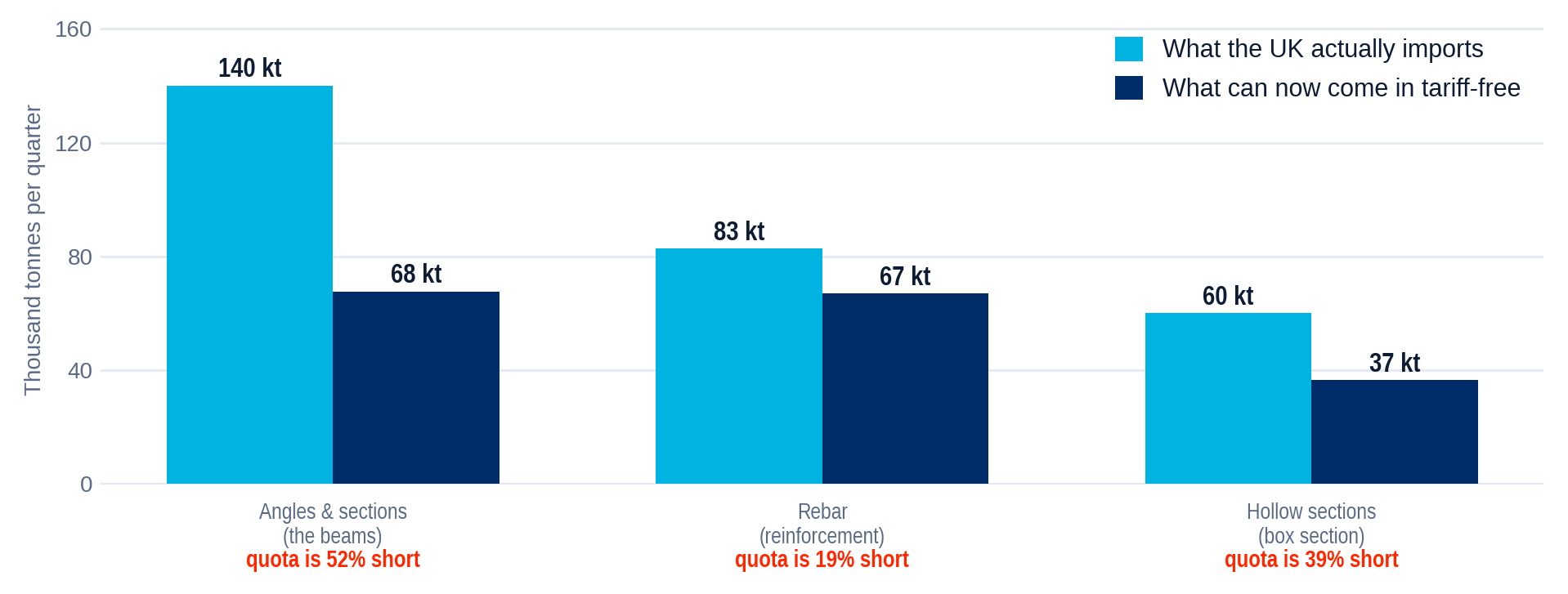
Since 1st July the UK has capped tariff-free steel imports, cutting quota volumes by 51% against the old safeguard regime and charging 50% on anything above the cap1. Compare those caps against what the country has actually been importing and the gap is significant. On angles and sections (the stuff that holds buildings up) the quarterly quota is about 68,000 tonnes against a recent run rate nearer 140,000. That’s a 52% shortfall, with hollow sections 39% short and rebar 19% short2.
On those figures, sure… a slow market and importers front-loading heavily before July may mean the last three months generate a flatter picture, but these are rounding errors. To fit inside the quota, section imports would have to fall by half. For context they fell 4% last year.
And we don’t really need to infer any of this, because this is the strategy - the Government said it out loud. The Steel Strategy wants domestic production to go from 30% of UK demand to 50%3. Setting a quota that comfortably fitted existing imports would not achieve that.
The problem is the clock. The whole thing relies on substitution: squeeze imports and demand moves to British mills. That only works if British mills meet the demand, and the tariffs arrive in a fortnight while capacity takes years. UK crude steel production has more than halved in the last ten years, from almost 11 million tonnes in 2015 to 4 million in 2024. That doesn’t just get reversed with a tariff schedule.
Take sections… 52% short and the UK has one producer: British Steel, melted at Scunthorpe and rolled at Teesside. That’s the substitute. And it’s also the company the Government took into full public ownership in July, having run it under ‘emergency control’ since April 2025, and which was handed a turnaround chairman in Alan Lovell two days ago. Expecting it to absorb an extra 70,000 tonnes a quarter, starting now, is a pipedream.
There is a plan for British Steel, to be fair - it has a £1.25bn proposal to move to electric arc steelmaking, with a furnace at Scunthorpe and consent already secured for a second on Teesside. That is the route to more British sections, and it is a good one. But it’s conditional on Government support (Government negotiating with itself) and it is measured in years.
Another flagship government investment does not fill this hole either. Port Talbot is building a 3.2 million tonne electric arc furnace with £500m of public money. What comes out is slab, rolled into coil. Coil becomes car body panels, tinplate for food and drink cans, cladding and profiled roof and floor decking, and some is slit and welded into structural hollow sections. So yes, Port Talbot does sit behind the hollow section supply chain but it is not going to make open sections (beams or columns). And just to note, this is still early in construction and won’t be online for another couple of years, at least!
Rebar is the exception. It is the least-short category at 19%, and it is the one where the UK actually has serious capacity: 7 Steel UK in Cardiff running the country’s electric arc furnace for rod and bar at around 1.2 million tonnes a year, almost entirely from UK scrap. They roll light sections too, but not structural sections. If you want to see what a genuinely circular UK steel business looks like, it is that one, and it has been quietly getting on with it for years.
So... where Britain can actually make the product, the gap is small. Where it cannot, the gap is enormous.
The question is not whether the shortfall is real. It is where it goes while the UK cannot fill it, which is the next several years. I can see three places.
One: somebody pays the tariff. Fabricated structural steel rose 17.7% in the twelve months to June 2026, against 6.0% for construction materials as a whole4. And that is inflation before the measure even started. And don’t forget the UK Carbon Border Adjustment Mechanism lands on 1 January 2027 on top of all this.
Two: the work leaves the country. This is the one that should worry people most. The quotas cover steel sections, but do not cover fabricated steelwork - maybe there is a sensible reason for this, but from the perspective of this piece, it looks like a loophole. The BCSA flagged this months ago: put a 50% tariff on the ‘raw’ beam and leave the finished/fabricated frame with no tariff, and you have created a generous incentive to buy the frame abroad.
Think about what that does to a UK fabricator. They buy raw sections at the tariffed price, fabricate in the UK, and quote against a foreign competitor who bought the same sections without the tariff, fabricated abroad and imports everything quota-free. For a Steel Strategy aiming to help the UK steel industry, this is doing the opposite - it hands a major disadvantage to a part of the UK supply chain that employs people in Yorkshire and the Midlands, and cannot relocate.
Three: it doesn’t get built. Projects that were marginal at £700 a tonne are not marginal at £950 plus a tariff and an uncertain lead time. No steel consumed, nobody employed.
Maybe there is actually a fourth option…
Reclaimed steel is not in any of this. No quota line, no tariff, no shipping, no mill lead time. It is already standing in buildings in this country, and it is immune to all three problems above.
For years we have led with carbon, because carbon was (and still is) a good argument. Steel reuse has also typically been cost-neutral or even slightly more expensive: what you save on material you give back in testing, certification, storage and risk contingencies. That equation just got updated. Every pound on the price of a new section is a pound of headroom for the reuse supply chain.
Being honest, steel reuse remains small in scale and it’s not suddenly going to solve this headache for large schemes (although why not push for some, e.g. 1%, reused steel on any scheme), but the marginal case has moved. Rooftop extensions, mezzanines, secondary steel, temporary works and refurbs… are perhaps now the jobs where reuse is the commercially sensible answer and the carbon is the free bit.
So do not forget to put a reclaimed option on the tender list. And if you are anywhere near a public sector job, the procurement side of this changes on 1 October too, which I covered in Quota Lottery.
Use less and be more efficient. The tariff schedule is doing the arguing for me this month!
https://www.gov.uk/government/publications/uks-steel-trade-measure-from-1-july-2026/uks-steel-trade-measure-from-1-july-2026
Tariff-free quota: GOV.UK, UK steel trade measure from 1 July 2026, Table 3, all countries of origin summed. Imports: HMRC Overseas Trade Statistics (uktradeinfo.com), 12 months to July 2026, all commodity codes in each category, divided by four.
https://www.gov.uk/government/news/uk-steel-industry-backed-by-major-new-trade-measure-and-strategy
https://www.bcis.co.uk/news/latest-construction-materials-prices/